Infrastructure and Transportation
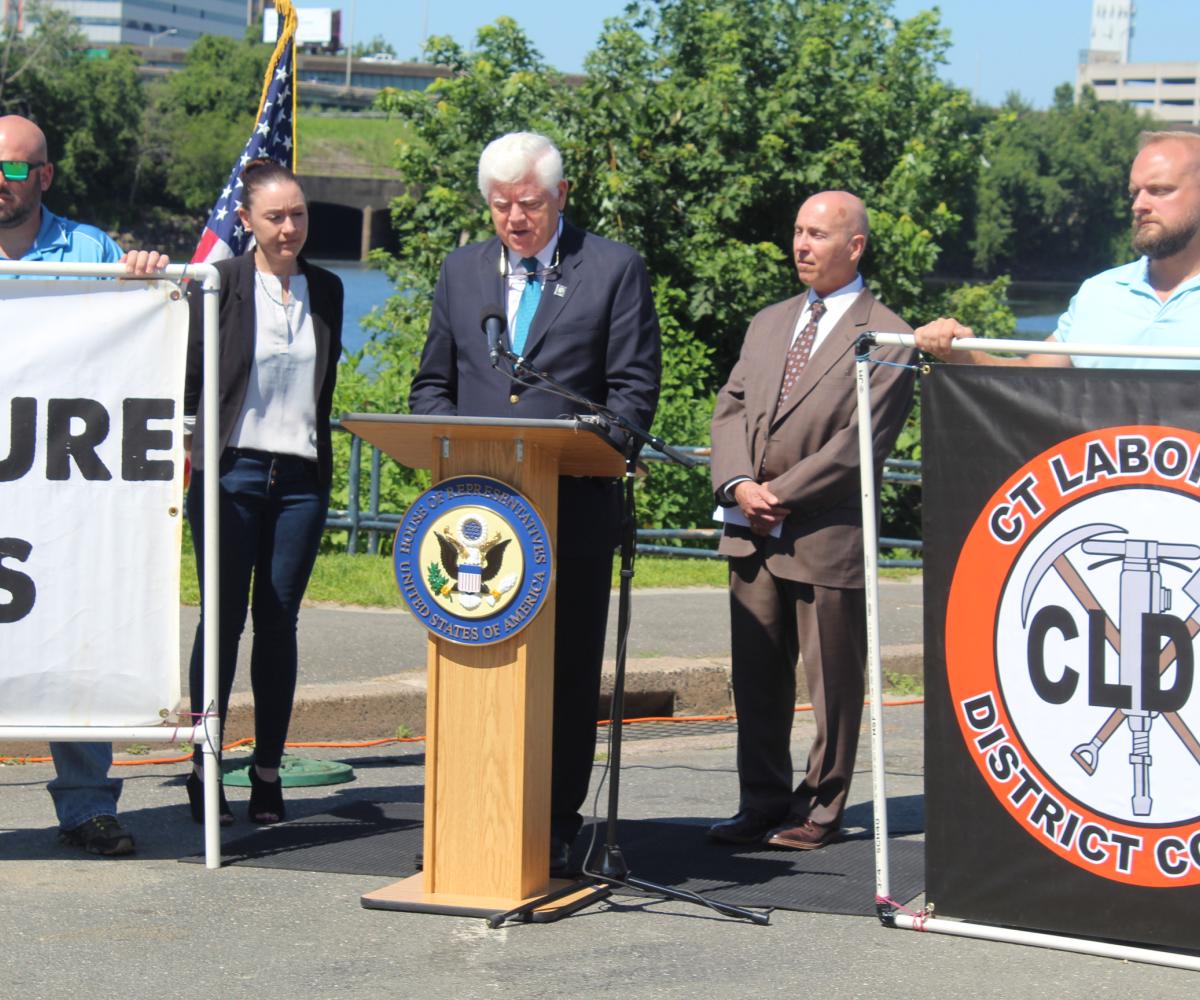
Connecticut’s First District is home to beautiful landscapes and public amenities, historic cities and towns, leading universities and commercial corridors, and so much more. However, our region’s transportation infrastructure currently divides neighborhoods, blocks access to the riverfront in the Greater Hartford area and has fallen short of serving those who depend on it. That’s why Rep. Larson is committed to making the region more accessible and pedestrian friendly by improving our highways, roads, trails and public transit options.
The Greater Hartford Mobility Study and Other Improvements in Hartford
In Hartford, the construction of I-84 and I-91 left the North End separated from the city’s downtown and cut off from the Connecticut River, creating racial and economic isolation. In East Hartford, the “mixmaster” interchange displaced neighborhoods in the South Meadows and now occupies an area the size of downtown Hartford. The post-war construction of the Interstate Highway System drastically altered the landscape in Hartford and East Hartford, and the consequences of these planning decisions are felt today throughout the region. The I-84/91 interchange and the Bulkeley Bridge are now the most congested traffic bottlenecks in all of New England for passenger cars and commercial trucks. This legacy infrastructure is costing hours of wasted time daily, harming economic growth, and polluting surrounding neighborhoods, jeopardizing the health of residents.
Rep. Larson has lived in East Hartford his entire life and is all too familiar with the challenges created by these planning mistakes. Determined not to repeat history, he brought together local leaders and stakeholders to advocate for a better future for the region. His advocacy led to the Connecticut Department of Transportation (CTDOT) initiating the Greater Hartford Mobility Study, a comprehensive, regional study of transportation and infrastructure improvements, in early 2020. Rep. Larson has since advocated for capping I-91 along the Connecticut River in Hartford to recapture the riverfront, capping I-84 in Hartford’s North End to reunite the city, and reducing the footprint of the “mixmaster” to reclaim valuable real estate in East Hartford.
He fought to ensure the inclusion of these recommendations in the Greater Hartford Mobility report, released in late 2023. Rep. Larson will continue to work with stakeholders and residents to define these projects and secure funding to implement them.
Rep. Larson is proud to have secured $4 million in Reconnecting Communities grant funding to reunite Hartford with its riverfront, a program he fought to include in the Bipartisan Infrastructure Law. This funding will allow CTDOT to complete preliminary engineering for the realignment, lowering and capping of I-84 in and the capping of I-91 from the Founders Bridge to Dillon Stadium in Hartford, including bicycle and pedestrian amenities on both sides of the river. Rep. Larson also secured a $19 million federal grant to make streetscape improvements along North Main Street, repairing and expanding sidewalks and making it simpler and safer for neighborhood residents to access public transit.
These grants, along with $4.5 million in federal funding to support the Hartford 400 initiative and an additional $1.6 million in federal funding for the city to reconstruct storm water drainage infrastructure in the North End, are putting the region in the best position possible to be able to improve its transportation infrastructure.
Better Connecting the Greater Hartford Area
The First Congressional District is heavily interconnected, and supporting infrastructure serves as a benefit to residents of the entire region and state. That’s why Rep. Larson has secured funding to help towns and cities reimagine their roadways to increase pedestrian and transit access, while opening up new opportunities for business and housing development. Rep. Larson has proudly secured millions in federal funding for local streetscape improvements throughout the district, including the notoriously dangerous Berlin Turnpike, to incorporate bus and bike lanes, expand sidewalks and improve accessibility.
These common-sense projects are strengthened by concurrent statewide roadway improvement programs, funded with over $4 billion in federal Bipartisan Infrastructure Law funds. In the First District alone, over $550 million in federal funding will help improve the highways and roads we use every day, from East Granby to Portland. Local road improvements and statewide infrastructure programs not only create jobs and improve pedestrian safety, but they lay the groundwork for our communities and state to build a more accessible region.
Planes, Trains, and Automobiles
Rep. Larson is working to ensure that our local downtowns are accessible by all modes of transportation. Federal funding awarded for projects in Berlin and Hartford, along with “main street” reconstruction programs in East Hartford, Manchester, and Windsor all include explicit plans to make our sidewalks more bus accessible, including better lighting, shelter structures, and signage. Rep. Larson’s support for the public transit system extends beyond building better sidewalks. He helped secure nearly $500 million for the establishment of the CTFastrak bus system, and $2 million to help the state to develop a mobile app, providing Fastrak riders with the ability to purchase tickets and track busses. Rep. Larson was also instrumental in securing $38.9 million to help the state purchase 46 new electric buses and charging ports.
Rep. Larson is also working to ensure that our railroad and airport infrastructure are upgraded to better connect the region. Last year, he secured a $2.5 million grant to help the state build a new, safer, more accessible Hartford train station, featuring a hub for CTFastrak. He previously helped secure $102 million in federal funds to double track the CTRail line extending from Hartford to Springfield, expanding passenger capacity and increasing the frequency of trains in Northern Connecticut. Rep. Larson also helped secure $17 million in federal funds for the state to build a new train station in Windsor Locks, connecting the region to Bradley Airport via commuter rail.
Improving and growing Bradley Airport remains one of Rep. Larson’s top priorities. His work on the Bipartisan Infrastructure Law alone brought in over $62 million to modernize the transit hub. This funding will go towards building a new baggage-screening facility behind the Sheraton Hotel, reconstructing and paving runways to expand airplane capacity at the airport, and conducting a major expansion to Terminal A to provide residents with more flights and locations to visit. Investments in our transportation capacity benefit all of us, helping better connect the communities in Northern Connecticut and beyond.
More on Infrastructure and Transportation
Washington, D.C. – Today, Rep. John B. Larson (CT-01) voted for HR 2, the Moving Forward Act.