In the News: Social Security 2100 Act
More on In the News: Social Security 2100 Act

March 2 marked the day that millionaire earners were finished paying into Social Security for the rest of the year. Working- and middle-class Americans, however, continue to pay all year long. If you think that’s absurd, it is.
The problem lies in the income cap that shields millionaires and billionaires from having to pay their fair share. Right now the wealthy are only paying their first $168,600 of wage income. They end up being taxed only on a small portion of their earnings while most Americans end up being taxed on 100% of their earnings.
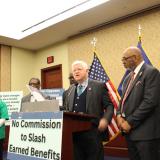
WASHINGTON - Today, Social Security Works and Data for Progress released new polling showing that voters overwhelmingly reject Social Security cuts, as well as the idea of a closed-door “fiscal commission” to determine Social Security’s future. Instead, they want Congress to raise taxes on wealthy Americans to protect Social Security.
Most Americans contribute to Social Security year-round, but U.S. millionaires will stop paying into the critical program on March 2—just over two months into 2024.
Rep. Larson and Nancy Altman, President of Social Security Works, wrote the following op-ed for Data for Progress:
When Mike Johnson (R-Louisiana) was elected speaker of the House, he immediately called for a “debt commission” designed to slash Social Security and Medicare behind closed doors.
At last year’s State of the Union, President Joe Biden memorably called out Republicans for their support for Social Security cuts.

Lawmakers and union leaders are calling on Congress for fiscal changes during the year. Along with conversations about the budget and fair pay, some lawmakers want more attention to Social Security.
The 2023 Social Security Trustee report showed trust-fund reserves could be depleted in 2034, meaning only 80% of benefits would get paid. It will fall to Congress and the White House to resolve it, but some are uncertain how it can occur given split opinions on Social Security.
Mary Cannon-James, president of AFSCME Iowa Retiree Chapter 61, spoke Thursday at a Capitol Hill event hosted by Rep. John Larson (D-Conn.), warning of the risks to older Americans like her if the Fiscal Commission Act (H.R. 5779) becomes law.
The bill is a solution in search of a problem. It would convene a group of experts – individuals who surely don’t or won’t depend on monthly Social Security checks to pay the bills – to address a so-called fiscal crisis that doesn’t actually exist.
A coalition of U.S. labor leaders spoke out forcefully on Thursday against the Republican-led push for a "fiscal commission," denouncing the proposal as an attack on Social Security, Medicare, and other programs that tens of millions of current and retired workers depend on to meet basic needs.
A proposed fiscal commission to fast-track deficit reduction measures, already under attack from the right, also faces a stepped-up assault from the left.
Rep. John B. Larson, D-Conn., led labor union leaders at a news conference Thursday to protest legislation that would create a bipartisan, bicameral commission that would devise a plan to curb red ink and require Congress to take an up-or-down vote on it with no amendments.